.png)


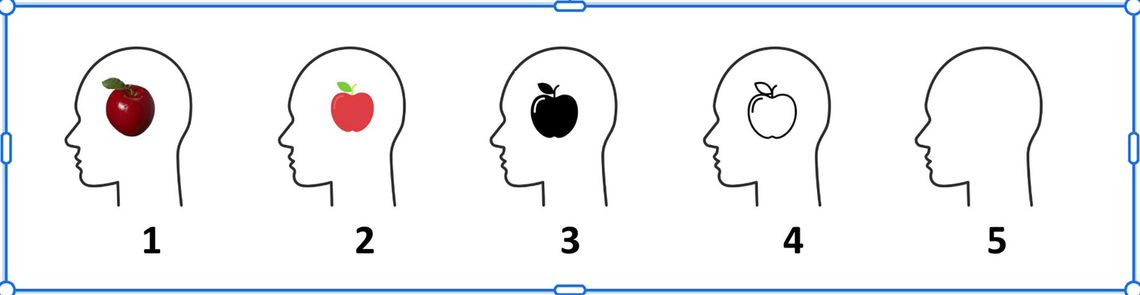
Creating art often requires an artist to voluntarily generate an image in their mind. Often this is of things that are familiar to them. A house, a tree, a flower or a red apple. The image in the mind’s eye is not like holding the real thing in your hand: Rather, it is as if you “pull up” an internal picture of that thing. At least, that is what most people can do.
Artistic “Vision”
In one of my first Dripping Springs Art League acrylic club meetings, two member artists and I collaborated on a single image painted across three canvases. The other two artists seemed so visually clear on how it would look. They worked decisively to choose and place strokes of color. I kept saying, “I’m lost, I don’t see where this is going.” They were kind and guided my contributions so that the result was a decent image. I left, thinking, wow, I have a long way to go in order to be a better artist.
In truth, I am a relatively inexperienced artist who benefits from more practice, but I gave myself a lot of grace after I learned about aphantasia.
The Aphantasia Spectrum
First described in 1880 by Francis Galton, it would not be until 2015 that Adam Zeman coined the term “aphantasia,” a variation of normal human perception. About 4% of people have a blind mind’s eye. When they are asked to visualize a red apple, their mind generates no image. They know what an apple is and they can describe it in great detail, but the internal image is missing. Current research suggests that a person can be on an aphantasia “spectrum.” Some people can see the shape of an apple in their mind, but not the color. And for some people, like me, the shape itself is a sketchy partial image or none at all.
Dr. Joel Pearson, professor at the University of New South Wales and Dr. Rebecca Keogh, formerly of Macquarie University have done ground-breaking research on aphantasia. Both are now affiliated with Future Minds Lab, which researches aphantasia. You can sign up on their website to get updates on their research or even participate in a study.
Pearson and Keogh, along with Alexei J. Dawes and Thomas Andrillon, published “A Cognitive Profile of Multi-Sensory Imagery, Memory and Dreaming in Aphantasia” in the Scientific Reports on 22 June 2020. They found that although there are some commonalities among aphantasia subjects, there are also a lot of variances. For example, many aphantasia subjects did not have vivid dreams, but many of the subjects did have vivid dreams. The last line of the study reads, “Visual imagery is a cognitive tool often taken for granted - an assumed precursor to our ability to think, learn, and simulate the world around us. This work demonstrates that such tools are not shared by everyone, and shines light on the rich but often invisible variations that exist in the world of the mind.”
Creative Work Arounds
What about creativity? It would seem that in order to generate original art one would rely heavily on “the mind’s eye.” According to the Aphantasia Network organization, “People with aphantasia often develop unique creative approaches, using abstract concepts, emotions, non-visual and non-sensory methods to innovate and create art across various mediums. Rather than limiting artistic expression, aphantasia often leads to distinctive creative processes.”
In a 2021 interview on “Wired Events,” Dr. Pearson states that people with aphantasia develop different strategies to compensate. In fact, those strategies can be a strength. For example, people with aphantasia often develop strong spatial skills.
In that same interview, Ed Catmull, computer scientist, animator and founder of Pixar, shared that he has aphantasia. Catmull shared that his associate, Glen Keane (animator, director and illustrator for Walt Disney) also has aphantasia. Wikipedia has a list of famous people with aphantasia who exemplify that aphantasia alone does not limit creativity or success.
The key take-aways are: Aphantasia does not limit creative artistic expression and can be a strength. So be kind when someone says, “I Cannot Picture It” because there is a 4% chance they really can’t.